A Twisted Crown of Thorns ®

Reformed. Christianity. Evangelism. Modern Culture.

Monthly Archives: April 2011

Charles F. Parham: Learning From Errors in Church History

Charles Fox Parham (4 June 1873 – 29 January 1929) was  an American preacher originally from a Methodist and the Wesleyan Holiness Movement back ground. Together with William J. Seymour, Parham was one of the two central figures in the development and early spread of Pentecostalism (which initially emphasized personal faith and proper living, along with a belief of the imminence of the return of the gifts of the Holy Spirit) in 1901 in Topeka, Kansas. Parham left the Methodist church in 1895 because he disagreed with its hierarchy. He also complained that Methodist preachers “were not left to preach by direct inspiration”. Rejecting denominations, he established his own itinerant evangelistic ministry, which preached the ideas of the holiness movement and was well received by the people of Kansas.

Charles Parham’s Theological roots

Pentecostalism grew out of the Holiness movement roots. John Wesley, the eighteenth century Anglican minister and founder of Methodism, is in many ways seen as “the spiritual and intellectual father of the modern holiness and Pentecostal movements” because of the doctrine of sinless perfectionism. Perfectionism (sanctification) was the second blessing or experience of the believer.  This perfectionism would become something a believer must seek and strive for. Read More…

Chart Showing Branches in Protestantism

I know this looks like a bunch of shoe laces soaked in rain, knotted up and left in the hands of a toddler but believe me its more than that. (Okay where do I begin?)

movements within protestantism

HT:Pure Church( click image to enlarge) Read More…

You Mean Spurgeon Did Not Even Make One Altar Call?

C.H. Spurgeon invited men to come to Christ, not to an altar.
Listen to him invite men to Jesus Christ

Before you leave this place breathe an earnest prayer to God, saying, ‘God be merciful to me a sinner. Lord, I need to be saved. Save me. I call upon Thy name….Lord, I am guilty, I deserve Thy wrath. Lord, I cannot save myself. Lord, I would have a new heart and a right spirit, but what can I do? Lord, I can do nothing, come and work in me to do of Thy good pleasure.Thou alone hast power, I know To save a wretch like me; To whom, or whither should I go If I should run from Thee? There’s More…

So If God Created All Things Did He Create Evil Too?

The bible says that God is Omniscient (all knowing) and Sovereign. He created the entire universe ex nihilo (out of nothing) and ordains or allows events and times. Nothing happens without His express permission. Yes, even wars, floods, tsunamis, holocausts and earthquakes. So then, some ask: How do you reconcile God’s Holiness with the evil all around us? Did a Holy God create evil? How could he fore see  Adam’s  fall from grace and let it happen?

THE objection may be raised that if God has foreordained the entire course of events in this world He must be the Author of Sin. To begin with, we readily admit that the existence of sin in a universe which is under the control of a God who is infinite in His wisdom, power, holiness, and justice, is an inscrutable mystery which we in our present state of knowledge cannot fully explain. As yet we only see through a glass darkly. Sin can never be explained on the grounds of logic or reason, for it is essentially illogical and unreasonable. The mere fact that sin exists has often been urged by atheists and skeptics as an argument not merely against Calvinism but against theism in general. There’s More…

God’s Sovereignty in Conversion of Zacchaeus

The story of Zacchaeus in Luke 19:1-10 goes: “Then Jesus entered and passed through Jericho. Now behold, there was a man named Zacchaeus who was a chief tax collector, and he was rich. And he sought to see who Jesus was, but could not because of the crowd, for he was of short stature. So he ran ahead and climbed up into a sycamore tree to see Him, for He was going to pass that way. And when Jesus came to the place, He looked up and saw him, and said to him, ‘Zacchaeus, make haste and come down, for today I must stay at your house.’ So he made haste and came down, and received Him joyfully. But when they [self-righteous unbelievers, probably Pharisees] saw it, they all murmured, saying, ‘He has gone to be a guest with a man who is a sinner.’ Then Zacchaeus stood and said to the Lord, ‘Look, Lord, I give half of my goods to the poor; and if I have taken anything from anyone by false accusation, I restore fourfold.’ And Jesus said to him, ‘Today salvation has come to this house, because he also is a son of Abraham; for the Son of Man has come to seek and to save that which was lost.'” Looking closely:

Zacchaeus is so very typical of the lost. The lost are those who are yet in their sins, lost from the fold of safety and salvation.

1) Zacchaeus was lost even though he had a good name. Zacchaeus means “the righteous one.” It may have been a noble gesture for his parents to bestow such a honorable name to him, but they could not bestow righteousness itself. He was, like every other member of humanity, from the womb a sinner (Psalm 51:5; 58:3), and therefore “a man who is a sinner” (v.7). Read More

A.W Pink on Modern Gospel Message.

It’s said real men love Pink and how rightly so in this instance:

“When addressing the unsaved, preachers often draw an analogy between God’s sending of the Gospel to the sinner, and a sick man in bed, with some healing medicine on a table by his side: all he needs to do is reach forth his hand and take it. But in order for this illustration to be in any wise true to the picture which Scripture gives us of the fallen and depraved sinner, the sick man in bed must be described as one who is blind (Ephesians 4:18) so that he cannot see the medicine, his hand paralyzed (Romans 5:6) so that he is unable to reach forth for it, and his heart not only devoid of all confidence in the medicine but filled with hatred against the physician himself (John 15:18). O what superficial views of man’s desperate plight are now entertained! Christ came here not to help those who were willing to help themselves, but to do for His people what they were incapable of doing for themselves: There’s More

Spurgeon on The Errors of Hyper-Calvinism

If you missed the Primer on Hypercalvinism I would beg you to have a look at a good definition of the term. (Hypercalvinism and Calvinism are poles apart). It is not surprising therefore to see that Charles Spurgeon strived to point out these errors of Hypercalvinism:

1.The hyper-Calvinist denies that gospel invitations are to be delivered to all people without exception. He limits the purpose of gospel preaching to bringing in the elect, and so only the elect are to be addressed with the commands, invitations and offers of the Word. There is to be no pleading with, exhorting and beseeching of an entire congregation of sinners. That attitude was totally rejected by Spurgeon, who on many occasions addressed every single hearer thus: “‘These are written that ye might believe that Jesus is the Christ, the Son of God; and that believing ye might have life through his name.” Look to him, blind eyes; look to him, dead souls; look to him. Say not that you cannot; he in whose power I speak will work a miracle while yet you hear the command, and blind eyes shall see, and dead hearts shall spring into eternal life by his Spirit’s effectual working’ (MTP, 40, 1894, p.502). There’s More

Video: George Whitefield -In The Words of Martyn Lloyd Jones

A brilliant documentary narrated by Dr. Martyn Lloyd Jones: George Whitefield was born on December 16, 1714, in Gloucester, England. The youngest of seven children, he was born in the Bell Inn where his father, Thomas, was a wine merchant and innkeeper. His father died when George was two and his widowed mother Elizabeth struggled to provide for her family. There’s More…

When John Knox Gave Mary Queen of Scots a Bloody nose.

Further in our study of church history we shall look at Scotland. In 1561, Mary Queen of Scots arrived in Scotland from France, and immediately issued an order to celebrate Mass in her private chapel. On hearing that, Mary’s relatives and attendants threatened to return to France, rather than live in a land where Mass could not be said, John Knox stated “Would that they, together with the Mass, had taken goodnight of this realm forever.” He denounced the Mass from the pulpit, concluding his sermon with the words that “one Mass is more fearful to me, than if ten thousand armed enemies were landed in any part of the realm.”

Knox well understood that this would only be the first step in a counter-reformation, designed to overthrow the work which had been achieved so far. His words were reported to Mary, and he was summoned to appear before her in conference. Mary accused Knox, saying,

[Here is the conversation]  Mary: “You have taught the people to receive another religion than that which their princes allow; but God commands subjects to obey their prince. Therefore you have taught the people to disobey both God and their prince.”

“Madam,” Knox calmly replied, “as right religion receive not its origin nor authority from princes but from the eternal God alone, so are not subjects bound to frame their religion according to the tastes of their princes, for oft it is that princes are the most ignorant of God’s true religion. . .”

“Well then,”, she said, “I clearly perceive that my subjects shall obey you, and not me; and shall do what they list and not what I command; and so must I be subject to them and not they to me.”

“God forbid,” answered Knox, “that ever I take upon me to command any to obey me or to set subjects at liberty to do whatever pleases them. . . My travail is that both princes and subjects may obey God. And think not, Madam, that wrong is done you when you are required to be subject unto God, for He it is who subjects peoples under princes, and causes obedience to be given unto them. . .”

“Yea,” replied the queen, “but ye are not the Kirk that I will nourish. I will defend the Kirk of Rome; for it is, I think, the true Kirk of God.”

“Your will, Madam, is no reason; neither doth it make that Roman harlot to be the true and immaculate spouse of Jesus Christ. . .”

“My conscience is not so,” said Mary.

“Conscience, Madam,” said Knox, “requires knowledge, and I fear that right knowledge, ye have none.” There’s More…

If God Is Sovereign, Why do Anything?

To deny the Sovereignty of God, people always first come up with this question-“If God is Sovereign, why do anything?” But what does the Bible say regarding God’s Sovereignty and human responsibility?

Fatalism

God’s sovereignty, as I am convinced the Bible teaches it, means that God has fore-ordained everything that happens. Before creation, God planned and decided (‘ordained’) the entire course of human history down to the smallest details. All circumstances in time are therefore the outworking of God’s plan which He decreed in eternity.

In light of this, a common objection is ‘If God has already decided what will happen, then why should I do anything? We don’t control history anyway. Therefore, we can just sit back and do nothing.’ The objector is saying that the logical outcome of belief in the absolute sovereignty of God is what we will call ‘indifferent fatalism’–the view that we should do nothing since God controls everything.

How are we to answer the objection of the indifferent fatalist? Why doesn’t belief in God’s absolute sovereignty lead to indifferent fatalism? And if God is absolutely sovereign, how can our choices have real meaning? These are very good questions that a proper understanding of God’s sovereignty will answer. Read More…

So Who Are The Reformed Baptists?

History

After the time of the apostles, churches continued to multiply everywhere. As the years passed, many churches began to depart from the teachings of the Bible. Superstition and human traditions were propagated as truth. Wars were waged in the name of Christianity. Immorality, idolatry and corruption were rampant in the so-called Christian world. The true Christians were a persecuted minority.

In the 16th century, God brought about a mighty stirring inEurope, causing many people to seek Him and hunger after the truth. This is now called the Reformation. Despite the attempts of the older churches to counter this movement, new churches were founded right through to the 17th century.

InEngland, the Particular Baptist churches arose in the first half of the 17th century. They were known as Baptists because, unlike the other reformed churches, they held to the baptism of believers by immersion. They were known as Particular Baptists because, unlike the General Baptists, they held to the doctrine of ‘particular redemption’, i.e. the belief that Christ died specifically for the elect. There’s More

Who Was John Owen?

Today we continue our study of church history. John Owen is the man we shall look at:

John Owen, called the “prince of the English divines,” “the leading figure among the Congregationalist divines,” “a genius with learning second only to Calvin’s,” and “indisputably the leading proponent of high Calvinism in England in the late seventeenth century,” was born in Stadham (Stadhampton), near Oxford. He was the second son of Henry Owen, the local Puritan vicar. Owen showed godly and scholarly tendencies at an early age. He entered Queen’s College,Oxford, at the age of twelve and studied the classics, mathematics, philosophy, theology, Hebrew, and rabbinical writings. He earned a Bachelor of Arts degree in 1632 and a Master of Arts degree in 1635. Throughout his teen years, young Owen studied eighteen to twenty hours per day.

Pressured to accept Archbishop Laud’s new statutes, Owen left Oxfordin 1637. He became a private chaplain and tutor, first for Sir William Dormer of Ascot, then for John Lord Lovelace at Hurley,Berkshire. He worked for Lovelace until 1643. Those years of chaplaincy afforded him much time for study, which God richly blessed. At the age of twenty-six, Owen began a forty-one year writing span that produced more than eighty works. Many of those would become classics and be greatly used by God. Read More

Legacies: R.C Sproul and John Piper

Ever wondered what Sproul’s initials R.C. stand for? oh well I will leave that for another Q and A. Speaking of legacies it is said R.C Sproul and John Piper are extraordinarily gifted preachers, prodigious authors, talented theologians. But they have never gotten over the stunning fact that they were treasonous rebels who were graciously summoned to the King’s banqueting table and clothed with the righteous robes of the King’s Son. “Between Two Worlds” has an interesting take on this:

sproul and piper

At one level, all Christians are the same. We are made in the image of God, saved by the grace of God, and live for the glory of God. We are blood-bought brothers and sisters, members of the same family, children of our heavenly Father.

On another level, we are each unique. The apostle Paul said that the body of Christ is like, well, a body: many parts, each with different shapes and sizes, each indispensable in characteristic and function.

The differences between R. C. Sproul and John Piper are easily discerned, even for the casual observer. I’m tempted to enumerate some of them, but it will be more fruitful to focus on the common threads that tie together their remarkable ministries.

Both men became Calvinists during seminary, as their resistance was overcome by God using a professor who insisted on taking God at his word.

Both men discovered and were deeply impacted by Jonathan Edwards during their seminary days. Oh There’s More!

Spurgeon And The Death of Jesus

This is an excerpt from Spurgeon’s daily devotional:

“I am poured out like water, and all my bones are out of joint.”- Psa_22:14
Did earth or heaven ever behold a sadder spectacle of woe! In soul and body, our Lord felt himself to be weak as water poured upon the ground. The placing of the cross in its socket had shaken him with great violence, had strained all the ligaments, pained every nerve, and more or less dislocated all his bones. Burdened with his own weight, the august sufferer felt the strain increasing every moment of those six long hours. His sense of faintness and general weakness were overpowering; while to his own consciousness he became nothing but a mass of misery and swooning sickness. When Daniel saw the great vision, he thus describes his sensations, “There remained no strength in me, for my vigour was turned into corruption, and I retained no strength:” how much more faint must have been our greater Prophet when he saw the dread vision of the wrath of God, and felt it in his own soul! …Read More

The Human Will: The Bird With The Broken wing

Excerpt from Loraine Boettner’s classic book The Reformed Doctrine of Predestination.

Loraine Boettner

Man is a free agent but be cannot originate the love of God in his heart. His will is free in the sense that it is not controlled by any force outside of himself. As the bird with a broken wing is “free” to fly but not able, so the natural man is free to come to God but not able. How can he repent of his sin when he loves it? How can he come to God when he hates Him? This is the inability of the will under which man labors. Jesus said, “And this is the judgment, that light is come into the world, and men loved the darkness rather than the light; for their works were evil,” John 3 :19; and again, “Ye will not come to me, that ye may have life,” John 5:40. Man’s ruin lies mainly in his own perverse will. He cannot come because he will not. Help enough is provided if he were only willing to accept it. Paul tells us, “The carnal mind is enmity against God; for it is not subject to the law of God, neither indeed can it be. So they that are in the flesh cannot please God:” Romans 8:7. To assume that because man has ability to love he therefore has ability to love God, is about as wise as to assume that …Read More

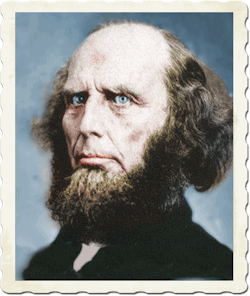
Revivalists: Along Came Charles Finney.

Excerpt from The Legacy of Charles Finney:

[Charles] Finney is particularly esteemed among the leaders of the Christian Right and the Christian Left, and his imprint can be seen in movements that appear to be diverse, but in reality are merely heirs to Finney’s legacy. From the Vineyard movement and the church growth movement to the political and social crusades, televangelism, and the Promise-Keepers movement, as a former Wheaton College president rather glowingly cheered, “Finney lives on!”

That is because Finney’s moralistic impulse envisioned a church that was in large measure an agency of personal and social reform rather than the institution in which the means of grace, Word and Sacrament, are made available to believers who then take the Gospel to the world…

To demonstrate the debt of modern evangelicalism to Finney, we must first notice his theological departures. From these departures, Finney became the father of the antecedents to some of today’s greatest challenges within the evangelical churches themselves; namely, the church growth movement, Pentecostalism and political revivalism.

Who Is Finney?

Reacting against the pervasive Calvinism of the Great Awakening, the successors of that great movement of God’s Spirit turned from God to humans, from the preaching of objective content (namely, Christ and him crucified) to the emphasis on getting a person to “make a decision.”

Charles Finney (1792-1875) ministered in the wake of the “Second Awakening,” as it has been called. A Presbyterian lawyer, Finney one day experienced “a mighty baptism of the Holy Ghost” which “like a wave of electricity going through and through me…seemed to come in waves of liquid love.” The next morning, he informed his first client of the day, “I have a retainer from the Lord Jesus Christ to plead his cause and I cannot plead yours.” Refusing to attend Princeton Seminary (or any seminary, for that matter), Finney began conducting revivals in upstate New York. One of his most popular sermons was, “Sinners Bound to Change Their Own Hearts.”… Read More

Significant Christian Martyrs in Africa and Asia

Throughout New Testament Christian history there have been children, men and women who have shed their blood to stand for truth and their faith in Christ marked them as “men of whom the world was not worthy”. Some of these people are never remembered and their sacrifices are taken for granted by many. Noll and Nystrom in the book, Clouds of Witnesses: Christian Voices from Africa and Asia describe in fantastic details the lives and significance of a lot of these martyrs:

Southern Africa
1 Bernard Mizeki (c. 1861–1896): The First Anglican African Martyr
2 John Chilembwe (c. 1870–1915): Holistic Christian and Accidental Rebel
3 Albert Luthuli (1898–1967): Gentleman of Justice

West Africa
4 William Wadé Harris (c. 1865 –c. 1929): Passionate Prophet
5 Byang Kato (1936–1975): Theological Visionary

East Africa
6. Simeon Nsibambi (1897–1978): Revival Anchor
7 Janani Luwum (1922–1977): Martyr of “the Second Century”

India
8 Pandita Ramabai (1858–1922): Christian, Hindu, Reformer
9 V. S. Azariah (1874–1945): Bishop, Statesman, Pastor
10 Sundar Singh (1889–1929?): Mysterious Mystic Read More

(Whisper) Can You Feel the Spirit in That Church?

The message in this clip will come in handy for those of you who are church hunting. What criteria do you use to choose a church?

Read More

What is The Elusive Ingredient of Most Revivals?

The whole theory of revivals is involved in these two facts; viz., that the influence of the Holy Spirit is concerned in every instance of sound conversion, and that this influence is granted in more copious measure and in great power at some times than at others. When these facts concur, there is a revival… ~Joel Hawes in Edward A. Lawrence, The Life of Joel Hawes.  Read More

You Could Be A Closet Pelagian If….

Pelagianism is the theological doctrine propounded by Pelagius, a British monk, and was condemned as heresy by the Church in 416 A.D. It denied original sin and affirmed the ability of humans to be righteous by the exercise of free will.  Here are ten clues you may be a closet Pelagian (Don’t scrowl at me I didn’t write them):

skeleton in closet

10. You believe that God has done His part, now you have to do yours.

9. You believe that every time you repent, God wipes your slate clean.

8. You believe that people are saved because they responded to an altar call.

7. You believe that it is unfair for God to command things people can’t do.

6. You believe that God helps those who help themselves.

5. You fear that the Rapture might take place before you get a chance to repent of your latest lapse from Christian character.

4. You think the Book of Life is written in pencil. Read More

10 Lessons To Learn From The Life of John Calvin

From a well written biography of John Calvin by Bruce Gordon. This excerpt comes courtesy of Kevin Deyoung:

1. If you want to make an impact beyond your little lifespan, teach people the Bible. “What made Calvin Calvin, and not another sixteenth-century writer was his brilliance as a thinker and writer, and, above all, his ability to interpret the Bible” (viii).

2. The big public personalities are often privately awkward. “In the public arena Calvin walked and spoke with stunning confidence. In private he was, by his own admission, shy and awkward” (x).

3. We read too much causality into our childhoods. “With his contemporaries, and much in contrast to our age, Calvin did not consider his childhood as psychologically formative: it was a brief and brutal preparation for adulthood associated primarily with ignorance, volatility and waywardness” (2).

4. The best friendships are forged in fire. “All his life Calvin would define friendship in terms of a commitment to a common cause; it was within that framework that he was able to express fraternity and intimacy” (29).

5. True strength is knowing your weakness. “However, one of his greatest strengths in his later career was an acute awareness that despite remarkable confidence in his calling and intellect he remained dangerously prone to moments of poor judgment on account of anger” (91). Read More

The Back Slider’s Anthem

One of the most tragic moments in life is watching a person who once professed to be a follower of Christ or was called a Christian become apostate and drift into rank unbelief and utter depravity. Apostasy doesn’t occur among pagans but among those who once were enlightened and appeared to have tasted of the gift of salvation. For some apostasy becomes an eternal state. But the Bible says there is great joy in heaven when one sinner comes to repentance. Just one sinner genuinely coming to repentance and faith in Christ…This puritan prayer has a rich quality to it. It is the poetical prayer of a repentant heart:

Lord Jesus, give me a deeper repentance, a horror of sin, a dread of its approach. Help me chastely to flee it and jealously to resolve that my heart shall be Thine alone.

Give me a deeper trust, that I may lose myself to find myself in Thee, the ground of my rest, the spring of my being. Give me a deeper knowledge of Thyself as saviour, master, lord, and king. Give me deeper power in private prayer, more sweetness in Thy Word, more steadfast grip on its truth. Give me deeper holiness in speech, thought, action, and let me not seek moral virtue apart from Thee.

Plough deep in me, great Lord, heavenly husbandman, that my being may Read More

Who Was Martin Bucer?

He may have been apparently forgotten as a theological light weight but to the keen eye Martin Bucer’s role in the reformation was and is invaluable. Bucer was an ecclesial diplomat pastor with deep coherent theological conviction.

Martin Bucer played a part in the Reformation and his impact was in the city of Strasburg. Martin Bucer is not as well known as Martin Luther and John Calvin but he did make an impact on Strasburg until he was forced to flee the city.

Bucer was born on November 11th 1491. He was influenced by the Humanistic teachings of Erasmus and he read and accepted the arguments of Martin Luther. He had been a Dominican monk but he left in 1521 and became the chaplain to Franz von Sickingen, a protestant knight, and in 1522 became pastor of Landstuhl in the Palatinate. Here he married Elizabeth Silbereisen – a former nun. In 1523, Bucer became a minister in Strasburg where he preached in the cathedral.

Strasburg had long suffered from poor priests in terms of quality and absentee bishops. The city was also a major centre of the book trade so it was very susceptible to the influence of the printed word. The writings of Martin Luther and Melancthon were widely circulated and as early as 1521, preachers had arrived in Strasburg to “preach the pure Gospel”. Read More

The Trojan Horse:Dominion Theology